
Chloride Contamination on Steel: Why Clean-Looking Surfaces Can Still Fail
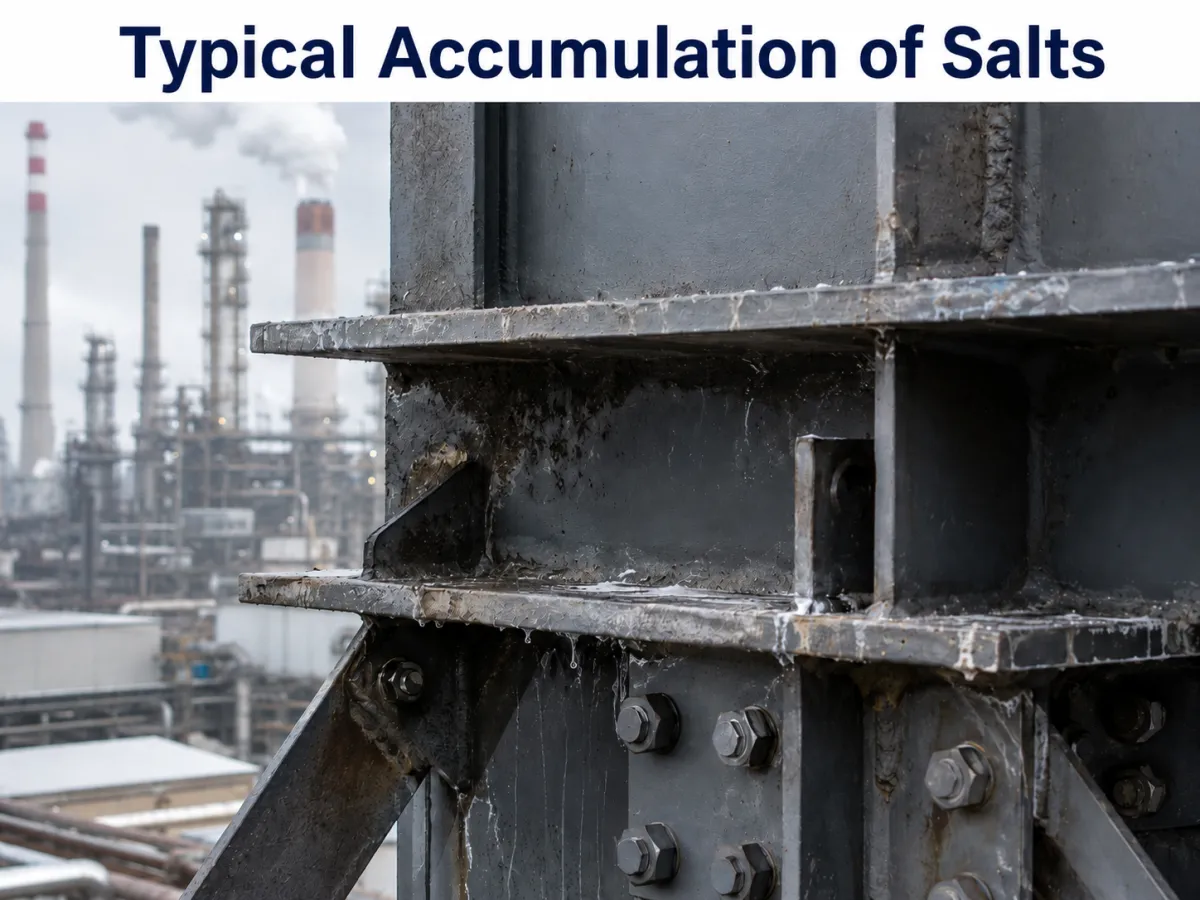
A freshly blasted steel surface can look perfectly clean. The profile may be sharp, the rust may be removed, and the surface may appear ready for coating. However, visual cleanliness does not always mean chemical cleanliness. One of the most dangerous hidden contaminants in protective coating work is chloride contamination.
For paint inspectors, coating contractors and specification writers, understanding chloride contamination is essential. Chlorides are water-soluble salts that can remain on steel surfaces even after abrasive blasting. If they are not detected and removed before coating application, they can cause premature coating failure, even when the coating system itself is high quality.
What is chloride contamination?
Chlorides are salts that are commonly found in marine and industrial environments. Steel structures exposed to seawater, coastal air, de-icing salts, cargo residues or contaminated wash water may carry chloride deposits on the surface. These salts are often invisible. They can remain in surface pits, weld areas, crevices and within the roughness profile created by abrasive blasting.
This is why a surface can pass a visual inspection according to a required preparation grade, but still fail later because soluble salts were left behind.
For international paint inspectors, this is a familiar risk on offshore platforms, ships, ballast tanks, bridges, port equipment, pipelines, storage tanks, wind turbine structures, refineries and steelwork in coastal or industrial areas.
Why clean-looking steel can still fail
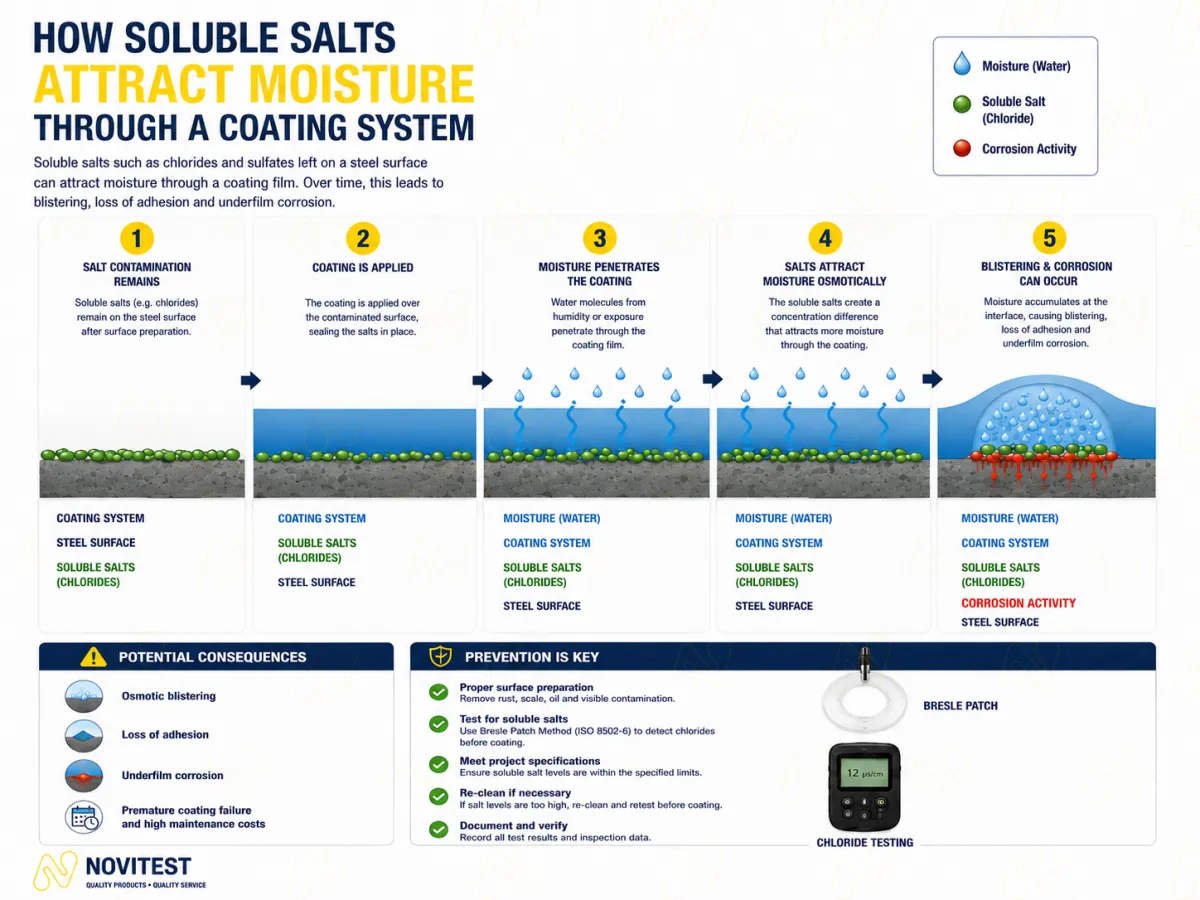
Protective coatings are designed to separate steel from the environment. But if chlorides are trapped between the steel and the first coat of paint, they can attract moisture through the coating film. This process is often linked to osmotic blistering.
In simple terms, chloride salts create a concentration difference beneath the coating. Moisture is drawn through the coating layers towards the contaminated area. Over time, pressure can build up under the coating, resulting in blisters, loss of adhesion and underfilm corrosion.
The problem may not become visible immediately. A coating can look acceptable after application and still fail weeks, months or years later. When that happens, the costs can be substantial: reblasting, recoating, downtime, access equipment, production delays and contractual disputes.
Why abrasive blasting is not always enough
A common misconception is that abrasive blasting removes all contamination. Blasting is excellent for removing rust, mill scale and old coating, while also creating the surface profile required for adhesion. However, blasting does not always remove soluble salts effectively.
In some cases, blasting can even expose contaminated pits or spread contamination over the surface. If chloride salts are embedded in the surface profile or trapped in corrosion pits, they may still be present after the steel looks visually clean.
That is why surface preparation specifications often include both visual cleanliness and soluble salt testing. A surface may meet the required blast-cleaning grade, but still require washing, reblasting or other treatment if chloride levels are too high.
How paint inspectors detect chlorides
Because chlorides are usually invisible, they must be measured. The most widely used field method is the Bresle method, described in ISO 8502-6 for extracting soluble contaminants from the surface. In this method, a Bresle patch is attached to the steel. A measured volume of deionised water is injected into the patch and used to dissolve soluble salts from a defined surface area. The extracted solution can then be tested, commonly by conductivity measurement or chloride-specific analysis, depending on the project requirements.
For coating inspectors, Bresle patch testing is practical because it can be performed on site before painting starts. It gives the inspector documented evidence of surface cleanliness and helps prevent hidden contamination from being sealed under the coating.
High-risk areas for chloride contamination
Chloride contamination is rarely distributed evenly. Some areas are more likely to contain salts than others. Inspectors should pay special attention to horizontal surfaces where water can remain, weld seams, pitted steel, splash zones, drainage areas, areas previously exposed to seawater, cargo tanks, ballast tanks, bolted connections and complex structures where cleaning is difficult.
For specifiers, this means that testing frequency and test locations should be clearly defined in the coating specification. A single test on an easy-to-reach area may not represent the true condition of the structure.
The role of the coating specification
A good coating specification should not only mention surface preparation grades and dry film thickness. It should also define requirements for soluble salt contamination before coating application.
This usually includes the test method, the maximum allowable contamination level, the number of tests, the test locations, the reporting format and the action required if results exceed the limit.
Different industries and projects may use different acceptance limits. There is no single universal chloride limit that applies to every coating system and every environment. The acceptable level depends on the coating type, exposure conditions, asset owner requirements and applicable standards or project specifications.
Preventing coating failure starts before painting
Once chloride contamination is sealed under a coating system, the risk has already been built into the job. The best time to control it is before primer application. Proper washing, controlled abrasive blasting, clean water, clean abrasives and reliable soluble salt testing all help reduce the risk of failure.
For paint inspectors, this means that chloride testing is not just a paperwork exercise. It is a critical quality-control step. For specifiers, it means that clear requirements for soluble salt testing should be included in the coating specification from the start.
Conclusion
Chloride contamination on steel is one of the main reasons why clean-looking surfaces can still fail after coating. The contamination is often invisible, but the consequences can be highly visible: blistering, loss of adhesion and underfilm corrosion.
For international paint inspectors, coating contractors and specifiers, the lesson is clear: visual inspection alone is not enough. Soluble salt testing with reliable Bresle patches provides an important safeguard before coating application.
By detecting chlorides before they are trapped under the coating, inspectors can help prevent premature coating failure and protect the long-term performance of the coating system.