
Understanding ISO 8502-6: Soluble Salt Testing Explained
In protective coating work, surface preparation is often the difference between a coating system that performs for years and one that fails prematurely. Paint inspectors, coating contractors and quality-control teams usually focus on visible cleanliness, surface profile and environmental conditions. However, one critical risk is invisible: soluble salt contamination.
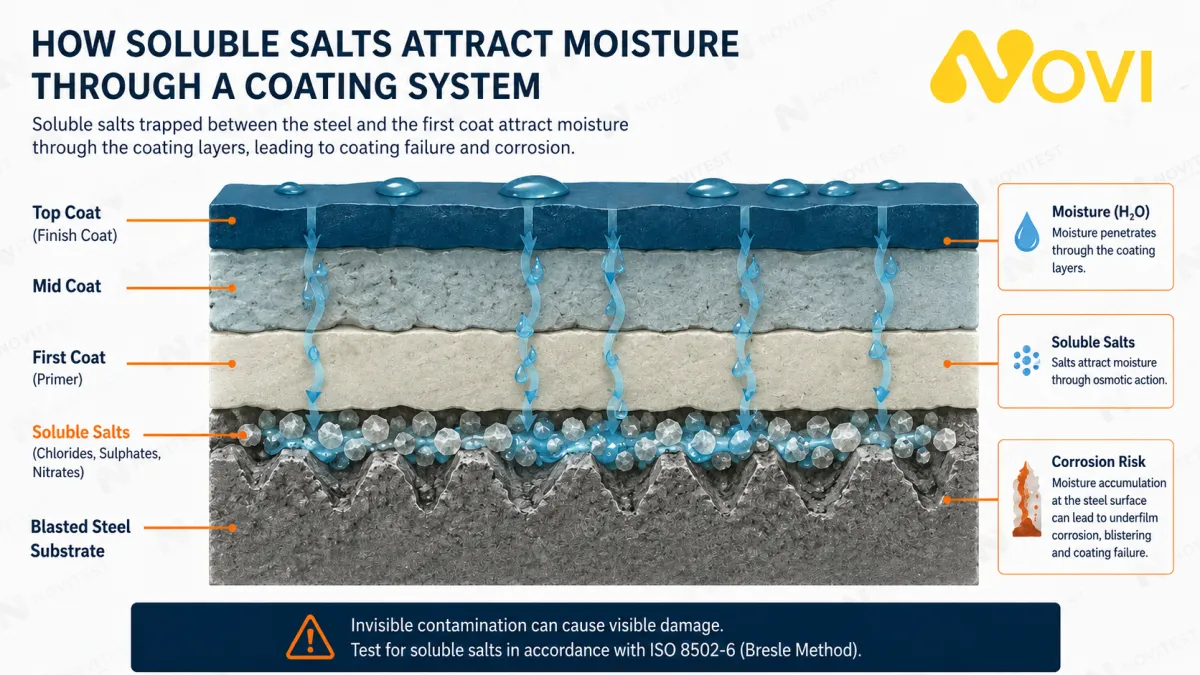
Soluble salts such as chlorides, sulphates and nitrates can remain on steel surfaces after blasting, washing or exposure to a marine or industrial environment. If these contaminants are trapped under a coating, they can attract moisture through the coating film. This may lead to osmotic blistering, loss of adhesion and early corrosion. That is why soluble salt testing is a standard part of many coating specifications, especially in offshore, marine, infrastructure and heavy industrial projects.
ISO 8502-6 describes the Bresle method: a field method for extracting water-soluble contaminants from a surface using an adhesive patch or sleeve. In practice, this is one of the most widely used methods for checking soluble salt contamination before painting.

What is ISO 8502-6?
ISO 8502-6 is part of the ISO 8502 series, which deals with tests for assessing the cleanliness of steel substrates before applying paints and related products. Part 6 focuses specifically on the extraction of soluble contaminants for analysis, commonly known as the Bresle method.
The standard does not simply say “measure the salt.” It describes how to extract contamination from a defined surface area using a known volume of liquid. The extracted solution can then be analysed, often by conductivity measurement in accordance with ISO 8502-9, to estimate the level of soluble salts on the surface.
For paint inspectors, ISO 8502-6 is important because it provides a recognised and repeatable field procedure. When used correctly, it helps prove whether a prepared surface meets the project specification before coating application starts.
Why soluble salt testing matters
A steel surface may look perfectly clean after abrasive blasting, but that does not mean it is chemically clean. Soluble salts are not always visible. They may be present from seawater exposure, de-icing salts, industrial pollution, cargo residues, previous service conditions or contaminated abrasives.
If coating is applied over excessive soluble salt contamination, several problems can occur:
- osmotic blistering;
- underfilm corrosion;
- reduced coating adhesion;
- premature coating breakdown;
- disputes between asset owners, contractors and coating suppliers.
In many projects, the cost of a failed coating system is far higher than the cost of proper inspection. For that reason, Bresle patch testing is often required before coating application on blasted steel, tanks, bridges, ships, offshore structures, pipelines and industrial equipment.
How the Bresle method works
The basic principle of the Bresle method is straightforward. A self-adhesive Bresle patch is applied firmly to the test surface. A measured amount of deionised or purified water is injected into the patch compartment. The liquid is then gently moved over the surface area inside the patch, allowing soluble contaminants to dissolve into the liquid. After the extraction period, the solution is withdrawn and analysed.
The result can then be converted into a surface contamination value, usually expressed in mg/m², depending on the measuring instrument and calculation method used.
Although the principle is simple, the reliability of the test depends heavily on correct technique and suitable consumables. Poor-quality patches, leakage, air bubbles, contaminated water, dirty syringes or inconsistent extraction times can all influence the result.
Why the quality of the Bresle patch is important
For paint inspectors, the Bresle patch is not just a consumable. It is a critical part of the measurement system. The patch must seal properly to the surface, hold the correct volume of liquid and allow extraction without leakage or contamination.
A good Bresle patch should offer:
- reliable adhesion to blasted steel;
- low risk of leakage during injection and extraction;
- a clean internal test area;
- consistent surface area and volume;
- easy handling in field conditions;
- compatibility with ISO 8502-6 testing procedures.
Field conditions are often far from ideal. Inspectors may be working outdoors, in confined spaces, at height, on curved steel or in poor lighting. A patch that is difficult to use increases the risk of mistakes. A patch that leaks can make the test invalid. A patch that introduces contamination of its own may create unreliable readings.
This is where professional-grade Bresle patches make a real difference. They help inspectors work faster, reduce failed tests and improve confidence in the result.
Common mistakes during soluble salt testing
Even experienced inspectors can get inconsistent results if the procedure is not controlled carefully. Common mistakes include touching the inside of the patch, using contaminated water, trapping too much air, damaging the patch during injection, not sealing the edges properly or failing to record the test conditions.
Another issue is testing too few locations. Salt contamination is not always evenly distributed across a surface. Localised contamination may be missed if the inspection plan does not cover high-risk areas, such as welds, horizontal surfaces, splash zones, drainage points or areas previously exposed to seawater.
The acceptance level for soluble salts is normally defined by the project specification, coating manufacturer, client or applicable industry standard. ISO 8502-6 describes the extraction method; it does not by itself define one universal maximum salt limit for every coating project.
Disposable versus reusable Bresle patches
Paint inspectors sometimes ask whether reusable patches are a cost-saving alternative. In practice, disposable Bresle patches are usually the safer and more practical choice for professional inspection work.
Disposable patches are supplied clean, ready to use and designed for single-test application. This reduces the risk of cross-contamination between measurements. Reusable systems, on the other hand, require very careful cleaning between tests. On a busy job site, this can be difficult to control. If a reusable cell is not cleaned perfectly, the next result may be affected.
For official quality-control work, traceability, cleanliness and consistency are more important than saving a small amount on consumables. One unreliable salt test can lead to coating failure, rework or contractual disputes.
Choosing Bresle patches for professional inspection
When selecting Bresle patches, paint inspectors should look beyond the lowest purchase price. The real cost of a Bresle patch includes handling time, failed tests, retesting, leakage risk and confidence in the result.
High-quality Bresle patches help inspectors perform ISO 8502-6 soluble salt testing in a controlled, repeatable and professional way. They are especially valuable when working on critical coating projects where documentation, compliance and reliability matter.
For coating contractors and inspectors, using the right Bresle patch is a small but important investment in coating performance. It supports better surface preparation control, helps avoid premature coating failure and provides clear evidence that the surface was tested before painting.
Conclusion
ISO 8502-6 is an essential standard for soluble salt testing before coating application. It explains how water-soluble contaminants can be extracted from a surface using the Bresle method, making it possible to assess invisible contamination that could otherwise compromise coating performance.
For paint inspectors, the message is clear: soluble salt testing is not a formality. It is a key part of professional surface cleanliness control. Reliable Bresle patches, correct technique and proper documentation help ensure that coating work starts on a clean, compliant and well-tested surface.
When coating performance matters, accurate soluble salt testing matters too. That starts with choosing Bresle patches that are designed for professional ISO 8502-6 field testing.